


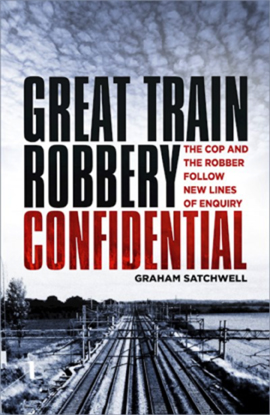
The ‘Great Train Robbery’ captured the imagination of the press and public in 1963 and long after. You might imagine that everything that could be said about the crime, has been. Not so, a former senior police detective found. His review of the case – with the help of one of the robbers, Tom Wisbey – is published shortly by The History Press.
Graham Satchwell challenges the idea that Bruce Reynolds was the leader of the gang; anything but; Graham says there is strong evidence that away from the scene there was a mastermind: “I think the mastermind employed ‘enforcers’ to make sure everyone kept their mouths shut’.” The book describes two gangs; one, well-known as the ‘south coast raiders’, stealing mailbags. Graham also details the robbers doing a ‘major rehearsal’.
Graham also writes of the then nationalised British Rail’s response to the robbery (‘which is unbelievable’) and the more junior railway staff who Graham is convinced were involved. As for insiders – and Graham names someone quite different from the man generally named – is it fair to say that any large crime such as the Great Train Robbery has to have an insider? If you look at the major robberies over the years, very often there has been, Graham agrees; and it occurs to Professional Security that you can add what we can call ‘self-insiders’, if building plans or other facts useful to criminals are on the internet for all to see.
Likewise it’s standard for robbers to seek to find out (like the Hatton Garden thieves of 2015) about their target.
Graham agrees that it’s important not to glamourise or to see the train robbers (like the Hatton Garden gang) as ‘Robin Hood’ figures against the state. “They weren’t heroes, they weren’t members of the Robin Hood gang, they weren’t working to the benefit of others. But then to see them as two dimensional characters who were just bad, is silly, because we all know if we look inside ourselves, we have good or evil within us. The picture is more complex than that.” The Great Train robbers, Graham adds, were neither the most evil people, nor folk heroes; they were, to a man, willing to inflict extreme violence ‘for the sake of not having to get up every morning and go to work; that’s a pretty big fault. It’s a very big fault, isn’t it?’
Here may lie a reason for the public’s and Hollywood’s continued interest in such true crime: “We all have a train robber inside of us; it depends what we do with that.” Another reason may be the moral lesson. While a ‘Mr Big’ may have lived a life of luxury as a result, most of the gang lived in relative poverty. Graham says pithily: “A life of crime is not a good career choice.”
What of the cynical belief that crime does pay? To that Graham replies that crime pays … if you don’t get caught. He puts it this way; if you choose to live your life in an open and honest way, then you find ‘birds of a feather flock together’; you gather around you people with similar values. If you live dishonestly, you will find around you people who are devious and self-centred who don’t care for others; and ‘it’s going to be a pretty miserable existence’.
The life of crime may be exciting to imagine; in reality, different. Graham hints that the same goes for policing, or the unpleasant parts of it; he recalls commuting with a woman who loved to read murder stories, including the forensic details. Graham didn’t want to read them; having actually attended post-mortem operations, and seen the guts and the brains; things you don’t want to be reminded of. Does that imply that the public’s very interest in crime (true or fictional) is vicarious, because most of the public don’t experience it? Long gone are the days when thousands gathered at Tyburn in London to watch hangings.
Hatton Garden, like the Great Train Robbery, has already had numerous books and films; indeed, a 1978 film about a fictional 1850s robbery referenced the actual 1963 crime – The First Great Train Robbery, starring Sean Connery and Donald Sutherland. Whether told as fiction or fact, the Hatton Garden and the train robbery criminals can easily be shown in an inaccurate and morally doubtful way – as romantic, endearing, even; in the case of Hatton Garden, elderly and unthreatening.
While mail trains and indeed physical mail may be part of a bygone world, Graham’s book shows that the 1963 robbery is well within living memory and resonates still.
Great Train Robbery Confidential, paperback, £9.99, is published by The History Press on October 1. Visit www.thehistorypress.co.uk.
More in the October 2019 print issue of Professional Security magazine.
Note; Ken Rogers, for many years a book reviewer and then columnist for Professional Security until his death, was a (young and junior) detective on the Great Train Robbery case.