




-optimized.jpg)








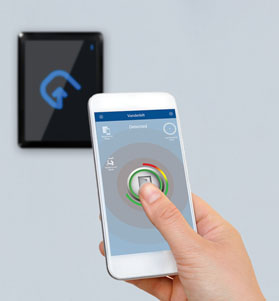
New from the manufacturer Vanderbilt, its Bluetooth Low Energy (BLE) readers, with the company’s ACT Enterprise 2.10 access control software.
Bluetooth Low Energy (BLE), according to the firm, removes the need for a physical card or tag and replaces it with a secure Bluetooth credential that communicates with the reader to authorise or reject access. Vanderbilt is releasing a range of BLE readers, a contactless door release button, virtual credentials available through an ACT Enterprise license, and a free end-user app, for Android and iOS.
Ross Wilks, Head of Marketing Communications, Vanderbilt said: “The Vanderbilt’s BLE readers remove the need for a physical credential and replace it with a virtual credential for smartphone devices that will provide customers with a far and smoother user experience. Importantly, when it comes to putting customers at the front and center of what we do at Vanderbilt, these mobile credentials are time and cost-effective alternatives to managing physical credentials. This will allow Vanderbilt customers to save not only time, but also money too.
“Again, with a customer-first mindset, mobile credentials are also extensively secure and are protected with the same grade of data encryption used by banks and hospitals. Moreover, our BLE readers can also act as a traditional card reader, meaning users can continue using MIFARE cards and slowly migrate to the Bluetooth virtual credentials at their own pace.”
The company adds that it’s offering a one-off license purchase as opposed to a subscription-based model that would include annual charges per virtual credential. Instead, the manufacturer’s license models means its customers won’t have any hidden or extra costs and can make significant savings in the long-term, it is claimed.
Nadine Frost, Product Manager, Vanderbilt, described it as a very straight forward approach. “The end user simply downloads the Vanderbilt Bluetooth app, and registers for a credential with the system administrator. Here, authorisation can be granted both offline and online.
“The system administrator then reviews and processes the request. This, in turn, sends the end-user a QR code that they save to their smartphone and link to their app to generate their credentials. Then all the end-user has to do is use the credential through the app on their phone when approaching doors with Vanderbilt BLE readers to gain access. Simple as.”
The BLE readers come with four identification modes for management: “Shake to Go,” “Show to Go,” “Manual Button Mode,” and “Hands Free Mode.” They’re also IP65 water-resistant with waterproof electronics. The readers and accessories work exclusively with the new release of ACT Enterprise 2.10.



