


Author: Randall Ferris and Dan Murphy
ISBN No: 9780-128027752
Review date: 27/04/2024
No of pages: 180
Publisher: Elsevier
Publisher URL:
http://store.elsevier.com/product.jsp?isbn=9780128027752
Year of publication: 06/01/2016
Brief:
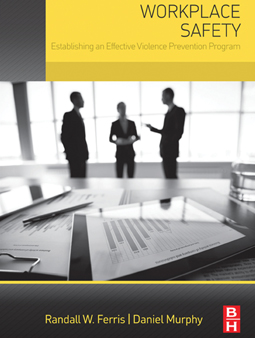
Workplace Safety: Establishing an Effective Violence Prevention Program, by Randall Ferris and Dan Murphy. Published 2015 by Butterworth-Heinemann, paperback, 180 pages, ISBN 9780-128027752, £26.34.
price
£26.34
One thing you soon learn in the book Workplace Safety, as anyone who has been to work should know, is that people bring their home lives to work with them, which can cause risks, quite apart from those arising from the place, or the sort of work, or the coming together of different people.
The two American authors open with forewords about their matter of fact but gripping backgrounds and what Randy Ferris calls ‘introduction to violence’; in his case because of a drunken father; in the case of Dan Murphy, by growing up in New York CIty then becoming a cop. Like many books in the field of security management, this covers American laws, definitions and regulations, in this case from the Occupational Safety and Health Administration, the US equivalent of the UK Health and Safety Executive (HSE). Either regulator can fine offending companies. As you might expect, the subject of workplace violence is much the same in the two countries; besides employers having a duty to act on it, they also have to be seen to act, for example by reporting.
The authors argue that an employer has to plan, as the right thing to do and to meet the legal responsibility; the authors face the arguments that employers don’t have to train staff or scare them (or spend any money) because bad things don’t happen in their neighbourhood. The authors give the example of an active shooter – who shot several colleagues when he was given the sack. Interestingly the answer is not to shoot back but ‘to recognise the behavioural warning signs’ that an employee need help, if they are arriving late for work, or not performing well. Having a ‘lockdown process’ does prevent a shooter having free access to roam, and kill several people (and perhaps including himself). Quite apart from allowing the employer to avoid legal liability.
It’s useful, then, that the book goes on to ‘overcoming rationalisations, objections and denials’ – all ways of shutting down the discussion. The book sets out how violence prevention can and should be part of ‘overall wellness’, taking in hiring, good communications, and reporting, besides the strictly security side, whether personnel (criminal background checks, drug testing) or physical: such as access control to keep the unauthorised out of the most sensitive parts of the workplace, or emergency alarm buttons. or ‘safe rooms’.
The book concludes with ‘high-risk terminations’, noting that planning for reduced violence does not give any guarantees, as they speak in terms of risk assessment; indeed, if the plans work well, it may shed light on intimidating or badly-behaving staff and result in ‘terminations’. How the employer handles the sacking, and delivers the message to the worker, can trigger violence. The authors offer some advice for ‘softening the landing’, such as who the ‘firing manager’ should be (some who can be tactful but clear) and what time of day (at the end of the subject’s shift) and what to say (’best to have a script’). And you don’t want the sacked person running into anyone that they may blame for the ‘termination’. Maybe hire a hotel room?
This book is a place to go to for such details on how to handle a sacking with potential to turn violent. The authors suggest also an ‘enhanced security plan’ to draw on if violence seems probable and imminent. And sadly but responsibly, the book closes with a chapter on ‘managing the aftermath of violence’ on what to do if an act of serious violence occurs on your premises, which takes in looking after the victim and family, the recovery of the business, and what to say to the news media.
As the book sets out, workplace violence is, naturally, disturbing, whether when it happens or if it’s feared or assessed as a risk. Workers can get sent unsettling things in the post; be harassed by former or present partners. The authors close with the hope that their book ‘will spark discussions in workplaces and help bring about the development of effective, reasonable, defendable programs designed to protect people by preventing violence’. They have done a good job.