


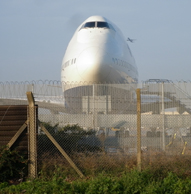
Seeking to cut costs while maintaining acceptable customer service, airports are adopting automation for repetitive tasks involving security and access control, according to a market research company. Pictured: the Heathrow airport perimeter.
In airports across the world, countless employees are tasked with sitting at entry/exit doors, scanning boarding passes and other tasks. These duties can be easily and effectively automated through electronics, according to a new report, “The World Market for Pedestrian Entrance Control Equipment” from IHS Inc.
“Automation at airports represents a huge opportunity for suppliers of pedestrian entrance control equipment, particularly those that specialize in speed gates,” said Omar Talpur, security, fire and access control analyst at IHS. “The first process that everyone thinks about—and the area where there has probably been the most progress—is boarding control.
“In most airports around the world, employees are tasked with scanning individual boarding passes while passengers idly wait. Automated boarding control provides airports with an opportunity to speed up the boarding process by deploying two to three speed gates in the boarding area to automate this process. In an industry where on-time departures are essential, any acceleration in boarding could potentially save millions of dollars each year.”
But if automation delivers so many advantages, why haven’t frequent flyers seen it deployed on a wider scale? the market researchers ask. The answer to this question lies in a number of factors that are inhibiting adoption.
Talpur said: “The airport environment is complex, and in most instances it takes years of planning and construction to roll out a solution that offers such radical changes. Automated boarding control won’t happen overnight. However, a snowball effect is inevitable as passengers and airport personnel become accustomed to working with the technology.”
To date, automated boarding control gates have been more prevalent in Europe than the United States.
“Many of Europe’s airports operate as for-profit businesses and are thus incentivized to cut costs and improve the traveler experience to keep passengers traveling and spending money in the airport,” Talpur noted. “Furthermore, in the United States, government agencies such as the Transportation Security Administration and the U.S. Customs and Border Protection play a significant role in airport safety and security. New technologies are required to go through rigorous processes and approvals before deployment, which creates hurdles for suppliers looking to sell product into U.S. airports.”
Pedestrian entrance control manufacturers that are not prepared with products that can serve this industry will have a steep hill to climb should they look to pursue opportunities within airports. Being first to market with an approved, reliable product will be critical to success, the market research firm adds.