


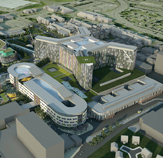
The largest single NHS hospital build in Scotland is the New South Glasgow Hospitals, part of NHS Greater Glasgow and Clyde. The development will give Glasgow the biggest critical care complex in Scotland.
CEM Approved Reseller Boston Networks is installing a multi-million pound ‘intelligent building’ solution for the new hospital which features the CEM AC2000 Security Management System (SMS), securing over 400 doors around the site. Building work began on site early 2010 and is due for completion in 2015. The main contractor on the project is Brookfield Multiplex Construction Europe Ltd.
The CEM AC2000 system will secure the new adult and children’s hospital. The new 14 floor adult hospital will house 1109 beds, emergency, acute receiving, critical care, 30 modern operating theatres, diagnostic services and in-patient and day case paediatric services.
Philip Verner, Regional Sales Director, EMEA, at Belfast-based CEM Systems, said: “At the New South Glasgow hospitals, AC2000 will provide a highly flexible and integrated security solution by linking to both Pelco Endura CCTV and Honeywell Galaxy Intruder Detection Systems. The CEM AC2000 system has many high level integrations in its portfolio, which enables it to act as a powerful Security Management System for South Glasgow hospital.
And Paul Goodbrand, Director of Intelligent Buildings, Boston Networks added: ‘‘Due to the sheer scale and complexity of the New South Glasgow Hospitals project, Boston Networks had to consider numerous factors when choosing our security partners, such as future proof technology, integration capabilities and the ability to provide a solution that would allow us to meet all elements of the installation and commissioning program”.
CEM says that its AC2000 system offers a set of software applications for site operations. The hospitals will use AC2000 VIPPS (Visual Imaging & Pass Production System), which allows users to design professional, quality ID passes which can include text, logos, graphics, photos, barcodes and signatures; and AC2000 AED (Alarm Event Display). AC2000 AED provides a dynamic and real-time graphical view of all alarms and events that occur on the AC2000 system.
As a new building with an Ethernet for its IT, the hospital was also able to use CEM’s Power over Ethernet (PoE). This means that only one Ethernet cable is required at the door, for simpler installation and time savings.
Paul Goodbrand added: “The technological capabilities of CEM’s unique Power over Ethernet (PoE) solution along with AC2000 met the needs of the Hospital’s multifaceted Access Control demands and also provided Boston Networks with the integration capabilities essential to deliver a robust and future proof IP security solution, within program and budget. By having complete control of the installation and working closely with CEM, Boston Networks will ensure that we meet and exceed the project milestones, installation and commissioning dates.”
CEM EtherProx readers will also be used to secure the site. EtherProx is an Ethernet card reader with keypad, LCD display and internal database giving off-line validation and intelligent decision-making at the point of entry, even when host communications are not available. EtherProx readers can display hospital card-holders with text descriptions on the swipe of their card: for instance, a hospital porter, trying to access the pharmacy, may get the message ’access denied’, and a red LED will flash indicating access has not be granted.