




-optimized.jpg)









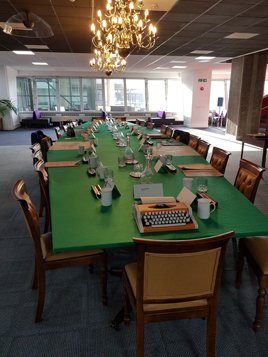
A widely hated Conservative Government new to power; such was the political scene in February 1980, when Prime Minister Margaret Thatcher decided on a review about leaks of Government information since her party had taken power from labour in May 1979. The file at the National Archives at Kew, Prem 19/357, sheds light on how central government sought to protect its sensitive info, so that it could go about its business, and shows the strikingly different way of working in a paper-only, pre-digital world, well within living memory. Picture by Mark Rowe; at Kew, a re-creation of the Thatcher-era Cabinet table; note Mrs Thatcher’s handbag on the left.
The conclusions of the review, as Mrs Thatcher noted in a ‘Dear Willie’ letter to Whitelaw in August 1980, enclosing the final report, were ‘not particularly far-reaching’. But, ‘if rigorously implemented’, should give some hope of significant improvement, she wrote. Her letter went to her two dozen ministers, plainly in the hope that they too would act to make leaks less likely. Tellingly Mrs Thatcher decided not to make a public statement, in case it was ‘provocative to the Press’. Ironically, given the subject, she was anxious to circulate the report to a minimum – in case of leaks.
The problem, under the new Conservative as under the previous Labour government; few inquiries into leaks got to the bottom of who did it; ‘and a series of leaks can be extremely destructive to confidence between ministers and officials’, as the report rightly stated. Although the report (by Sir Nicholas Morrison, a former permanent secretary) did not spell it out, each side might suspect the other of leaking to serve their own interests; a lack of trust made the business of government harder to do.
Particularly disturbing, according to the report, was that recent leaks had included documents, including some Cabinet office papers. While there was no evidence of any subversion, clearly loss of documents was more worrying in terms of security than an oral leak which could be ‘merely indiscreet’ due to someone overhearing you at Westminster. Nor was there any evidence of a regular flow of leaks to any one newspapers. As the report admitted, ‘a plain envelope through the post is a virtually risk-free method’, to send leaked items to the press. and the report admitted that ‘by far the most effective deterrent would be one successful investigation resulting in dismissal’ of the leaker …. but there seems to be a fair degree of probability that deliberate leaks are more likely to come from middle or junior members of the [civil service] staff with relatively rate access to sensitive documents; in only one or two cases has any suspicion centred on senior staff’. That made sense; the more senior you were, the more you had to lose. The report went on to motivation of the leaker; it was less likely to have been political ‘in the party political sense than to have arisen from a strong social consicence’. Nor was there any evidence of leaks for a ‘financial motive’. Some central government departments had more confidential documents than others. The report admitted there was no panacea; and ‘the only real precaution lies in the loyalty and sense of responsibility of individual servants’; as the report could have added, invisible and intangible; unprovable. As the report went on, civil servants were looking to strike for better pay; ‘not a favourable climate’.
What to do? The report suggested that leak procedure needed revising. Filling in a questionnaire was not working – after a leak, those who might have handled the documents or had knowledge of the leaked facts had to fill in and sign an A4 piece of paper to confirm or deny they had contact with the journalist or newspaper concerned. While leaking of a Government document was a criminal offence under the Official Secrets Act 1911, it was simple to make a denial.
Thus the report recommended ‘narrowing the field’; securing the most important documents, accepting that the government made so many. Cabinet office papers, letters between ministers, and ‘papers of development’ of policies and sensitive policy options, were listed as most important. Here the report admitted that sensitive documents in terms of national security was not the same as ‘politically sensitive to a party in power’ which were rarely classified. And if the authorities made a new security marking, such as ‘policy in confidence’, that might ‘simply act as a magnet to the potential leaker’. Hence the report recommended applying the ‘need to know principle’. As that implied, this report did not have much new to say.
It described the photocopier as ‘the villain of the piece’. It did not that an identifying device would be available soon, to mark a copied documents to a particular photocopier; as a deterrent to a leaker copying a document and leaving the original apparently secure. And the report recommended including anti-leaking in civil service staff induction training. As for what to do about major leaks, it recommended oral questioning; and a central bank of cases, outside the normal filing system. That said, Sir Nicholas recommended minor leaks should always be investigated, because they might give clues to future leaks.
Sir Nicholas proposed ‘a more professional standard of investiation of leaks …. Which should include individuals experienced in interrogation techniques (eg ex-policemen retired, Inland Revenue or Customs investigators [in 1980 the Revenue and Customs were not yet together in HMRC] or ex-members of the Security Services.’ In other words, specialists, and an end to calling in the police, because that only produced ‘more of a rumpus’. That is, to make a crime of a leak was counter-productive, because civil servants resented it.
The report went on to a review of 22 leaks since May 1979 when the Conservatives took office from Labour under James Callaghan. Some of the 22 had dated from Callaghan’s time. of the 15 investigations completed, the authorities had found two culprits and five suspects. By comparison, in five cases, no detailed report was kept. Mostly, the reason for leaks appeared to be to embarrass the government, or out of a sense of the public interest.
Bernard Ingham, chief press secretary to Mrs Thatcher, having read the report, pointed out four named journalists who had consistent bylines with leaks. The first named was Peter Hennessy of The Times (now Lord Hennessy).
Mrs Thatcher had raised the issue of the ‘unprecedented’ number of leaks to her Cabinet on January 31, 1980. The Morrison review was (ironically) to be covert and knowledge of it restricted, ‘to those with a need to know’. As an earlier memo had put it, the PM had ‘no great hope’ that the Morrison study would produce anything. As a paper beforehand by Sir Ian Bancroft said, there was a ‘climate’ for leaks because of pressure groups; which Sir Ian defined as ‘misguided people rather than political extremists’. Clearly government closely followed the press in general, and leaks in particular, because a list of leaks from May 1979 showed eight publications.
Another file Prem 19/362 takes up the story and throws light on cases of leaked Cabinet committee documents, to Time Out magazine. Police suspected someone in the Inland Revenue, because of some workers’ there ‘association with persons of extreme political views and apparent interest in anarchist literature’. But an (unnamed) person was not going to be prosecuted. Instead, the authorities only proposed to deny that person future access to sensitive information. That is, a day in court would only turn a leaker into a martyr.
Police were linking two leaks about dole payments to strikers, and nuclear reactors. Time Out had revealed documents of minutes that had come to it anonymously in the post. Because these leaks were so blatant, police were called in; as they had been in 1976, when a paper about child benefit was leaked to the social justice campaigner Frank Field (later a long-serving Liverpool Labour MP who only lost his seat at the December 2019 general election). The front page of the Guardian for December 6, 1979 covered a Cabinet committee chaired by Mrs Thatcher, which had backed a new sort of nuclear reactor.
Other leak stories: one – after Sun exclusive in 1970, PM Edward Heath makes ministers sign a denial they had anything to do with the leak to a political journalist.
Two – fast action by Heath after a claim that trade figures were leaked to the markets.
Three: somebody forgot to check what confidential files were in a filing cabinet before it left Downing Street for sale on the second hand market in Loughborough.
Four: a minister had to move fast to deny all knowledge of being behind a summer 1970 leak to the press about junior ministers’ salaries.



