-optimized.jpg)









Author: Daniel McCarthy
ISBN No: 9781 137299383
Review date: 24/06/2026
No of pages: 187
Publisher: Palgrave
Publisher URL:
http://www.palgrave.com/products/title.aspx?pid=652423
Year of publication: 17/04/2014
Brief:
Soft Policing: The Collaborative Control of Anti-Social Behaviour
price
£58
Despite some mixed messages coming from the Coalition Government – and where have we heard that before?! – the use of anti-social behaviour orders (ASBOs) as begun by Labour continues. But who gets an ASBO, and how and why? An academic study of the field of ‘soft policing’ takes us inside the meetings by police and others.
Daniel McCarthy, a University of Surrey criminologist, has sat in on case conferences in two unnamed places. Despite some lapses into jargon – what on earth does ‘women police operate in agentic ways’ mean?! – McCarthy has vivid ‘fieldnotes’ and interviews with police and youth offending officers. To define ‘soft policing’ briefly, it’s more like social work, and the opposite of ‘hard’ policing (kicking doors in, putting handcuffs on offenders). While business crime partnerships on behalf of retail and other members have put cases together to gain ASBOs against offenders – who may be anti-social to shop staff and shoppers generally – businesses hardly feature either in McCarthy’s analysis or what the police and other professionals have told him. Either he’s left it out, or the crimes against businesses are merely wallpaper in the background of all the efforts by state employees to help the troublesome, often young people, before they do crime, or worse crime. Readers may shake their heads at all the crime mentioned in McCarthy’s cases in passing – truanting, shoplifting, drunkenness, abuse shouted at passers-by, racial abuse of shopkeepers, and petrol stations robbed. In fairness, McCarthy does have a background in crime partnership working; the victims and the crimes were not the author’s focus; he was studying the ‘soft’ work of the police and their partners.
The writer offers some telling insights into the way what we can call for short ‘ASBO people’ get managed – for instance, just moving the offenders off your patch, so that they’re someone else’s problem – often seaside towns. McCarthy also shows evidence that ASBOs are one more game in the criminal justice system. What’s the outlook for ASBOs and soft policing? Will they wither in austerity? Or has police culture changed, and enough police see that ASBOs and ‘acceptable behaviour contracts’ do bring successes? Alas anti-social behaviour, caused at least partly by ‘rubbish parents’, shows no sign of lessening. Would more state support for at-risk youth, more ‘intervention’ cut crime and disorder – or is that part of the problem?
McCarthy’s book has much to say about crime prevention, women doing police work, and British society. It’s a nuanced, assured and most worthy addition to Prof Martin Gill’s crime prevention and security management series of book for Palgrave, which includes to name only a couple Prof Joshua Bamfield’s Shopping and Crime; and Rachel Armitage’s Crime Prevention through housing design. Over several years now this has built into the most weighty and useful series of books on UK crime prevention and security management around.
You can download chapter one as a sample at – http://www.palgrave.com/PDFs/9781137299383_sample.pdf
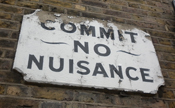
Pictured: a street sign in Southwark, south London