




-optimized.jpg)









Author: Keith Still
ISBN No: 9781466579644
Review date: 23/06/2026
No of pages: 300
Publisher: CRC Press
Publisher URL:
http://www.crcpress.com/product/isbn/9781466579644
Year of publication: 26/08/2014
Brief:
Introduction to Crowd Science, by Keith Still. Published 2014 by CRC Press, hardback, 300 pages
price
£64
Introduction to Crowd Science by G Keith Still is an authoritative book on a topic that applies across security and event management that could save plenty of lives – and careers.
A list, a depressingly long list, of more than two pages in Prof Keith Still’s books covers the crowds that have had dead and injured whether because of panics, rampages or plain too many people crushed into too small a space. And as Still points out, many more near-misses go unreported. Most of the cases from the list are from the developing world – China, India, Indonesia, where admittedly crowds can number in the millions, for instance for pilgrimages. But the UK has Hillsborough (96 dead, plus the often overlooked 400 injured) and the crush at a JLS open-air concert at Birmingham, though no-one was killed.
Still makes a good case that the event safety management field he works in should have the title he gives it ‘crowd science’, through use of computer modelling and mathematics, and understanding of human and crowd psychology. Yet the maths can be brutally simple: too many people too close together cannot move freely, and may fall over and die, and kill others in the crush. The photos on the front cover show sports fans inside and outside a stadium, but one of Still’s points is that events can be so varied: a Christmas lights switch-on in a market place, a fireworks show for charity, a pop concert at a football ground in summer, even a flash mob – though unlike the rest that’s by its nature not given an assessment or documented plans beforehand, and not covered by Still, though it’s one for building and security managers of shopping malls or railway terminuses to consider.
Talk of panic and the like, as Still points out, as used emotively in the mainstream media, may imply that a crowd was at fault – which we can add suited the authorities after the Hillsborough disaster of 1989. “However, when you examine the failures of each incident, a different picture emerges. The most common element of failure we encountered when reviewing the incident database was the fact that design capacity and throughput limits were exceeded. In many cases they were unchecked or unknown before the event, and the result of exceeding these limits was overcrowding.” In other words, as Still points out earlier in his work, deficient planning – before anyone has passed through a turnstile or handed over a ticket at a gate – and ‘unsatisfactory risk management during events’ are to blame.
Still puts across how varied the risks are and how the monitoring of crowds has to be constant (’dynamic risk assessment’). This explains why, at every football match I have sat in on with the safety manager and in the control room, there’s such interest in the estimated number of attenders, and the actual number as registered from the clicker at the turnstile. If you’ve budgeted and prepared and have rostered for enough stewards for 5000 fans, if it’s a fine day or the ticket price is lowered for whatever reason or the game suddenly becomes more important, and 10,000 attend, suddenly (but as Still points out, with causes you can plot if only you assess well enough) you might lack the numbers to manage the event. And that applies to far more than sports matches; the appendix of ‘crowd disasters’ includes the opening night of the IKEA store in Edmonton in north London, cut short after so many people turned up.
The sceptics with health and safety in general may scoff that even if crowds do need managing, it’s done in too bureaucratic a way and it’s too costly. To his credit Still is realistic and begins a final chapter, ‘the way forward’ by arguing that crowd safety can and should be done ‘at low cost’ and with ‘minimum skills’. From experience he adds that too often plans are plainly from the year before and merely have a new date and event name cut and pasted into the old document. A 14-page appendix briefly detailing disasters of recent decades, as recently as early 2014, is depressing. It seems as Still suggests that people keep making the same mistakes. Barriers break, exits are locked, walls collapse. “Accidents do not just happen; there is always a cause!” This book is of use not only to the manager (security or general) who is in charge of any event with a crowd expected, whether a promotion or some grand opening in a mall or a pop star’s appearance, but for any security person who may be in the vicinity, whether a transport hub or a neighbour, or public space CCTV controller. Also impressive and striking in this book is the author’s grasp of how many factors can affect a crowd and its safety: if it’s such a large crowd (on the streets of London for New Year’s Eve or a royal wedding, let’s say) that it has electronic signage, what should signs tell crowds? If there’s a threat, where do organisers tell crowds to go? Is it safer not to evacuate? Is there a no-alcohol or no glass bottles policy? If so, and it’s enforced by searches at a perimeter, does that result in a queue and crowding? As Still explains, time is also a factor: in an emergency, all of several options have risks; if a guard force or police intervene because of, for example, disorder or fire, does that risk a dangerous rush of the law-abiding for the nearest exits (and if so, how to mitigate that? A message on the public address system? If so, what?).
To sum up, this book is required reading for anyone who works with assemblies of people – from night-clubs to political party conferences. And what makes it so is that it has academic and scientific rigour but is presented in a readable and practical way, answering real and indeed life and death issues. Learn from this book and then you may not meet the author as an expert witness at a court or an inquiry.
Introduction to Crowd Science, by Keith Still. Published 2014 by CRC Press, hardback, 300 pages. ISBN 781466579644. Price: £64 online. Visit www.crcpress.com and www.sponpress.com.
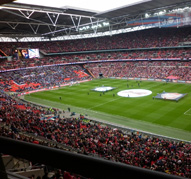
Pictured: Wembley Stadium, FA Cup semi-final, Arsenal v Wigan, spring 2014, on the occasion of ceremonies around English football grounds in memory of Hillsborough.



